
Capital City Aikido has been providing a safe and encouraging environment for martial arts training and self-development for over 25 years. Our goal is to provide our students with effective tools for dealing with conflict (both physical and non-physical) in powerful and decisive ways, while also learning how to use conflict as a pathway to peace.
Empowering people toward benevolence and compassion.
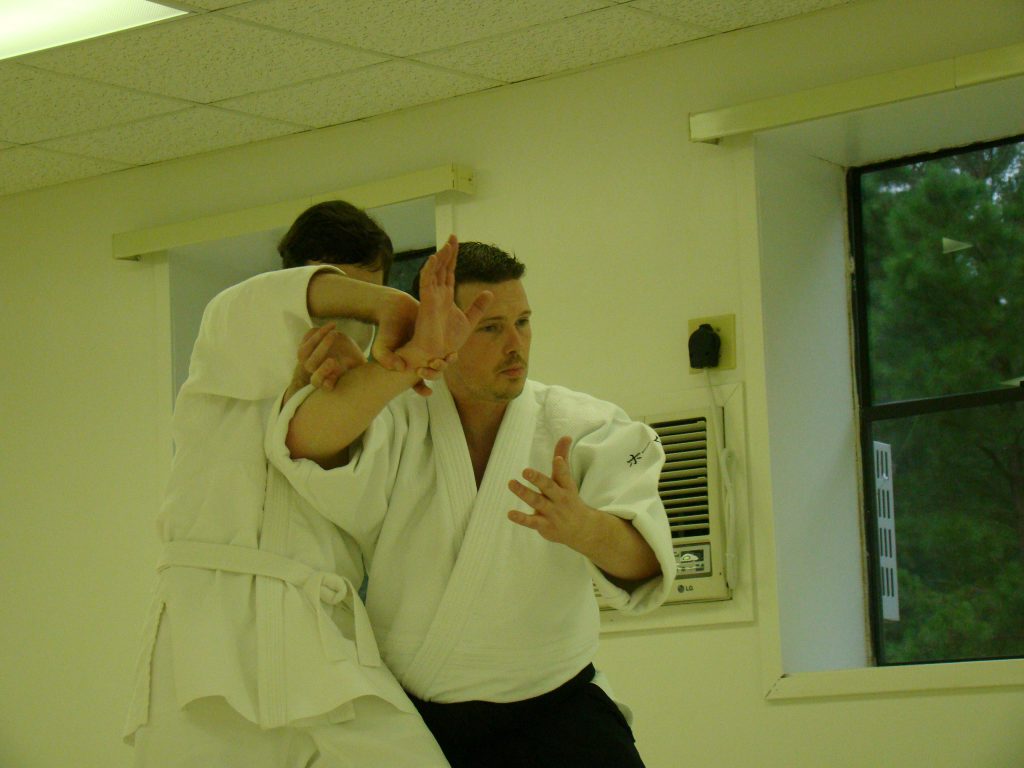
Meet our instructors
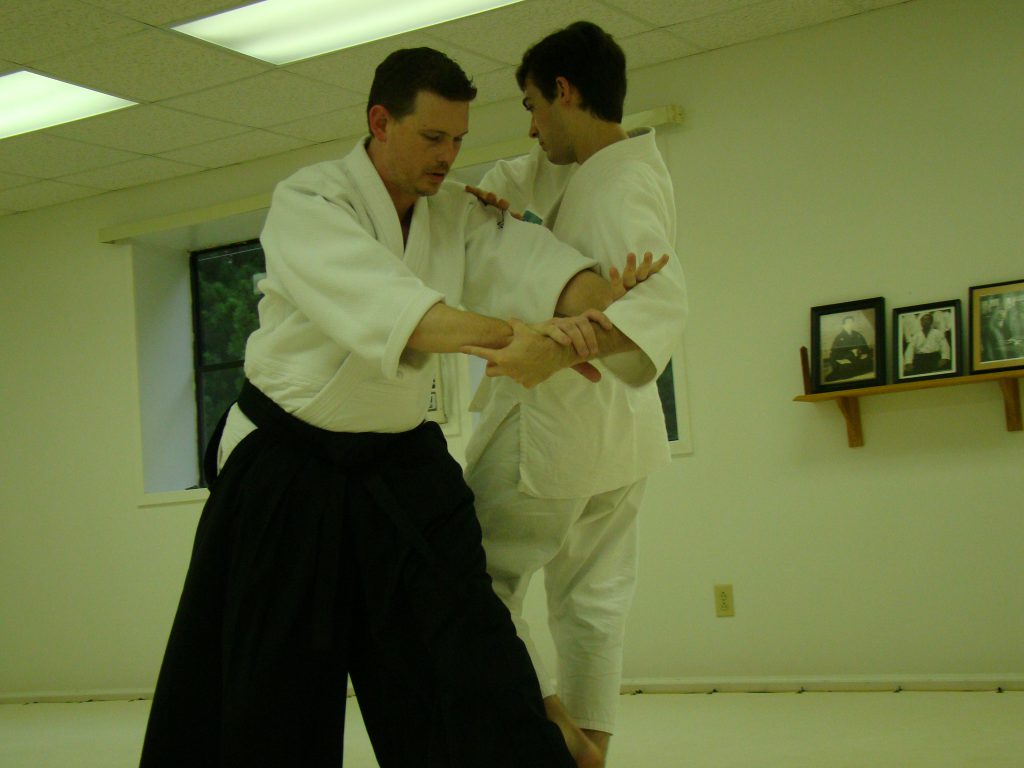
Holmes King (Sandan/Dojocho)
Holmes began training at Capital City Aikido in 2002 and took over leadership of the dojo when his instructor, Ron Myers, retired from teaching in 2011.
FAQs
What is Aikido?
Aikido is a traditional Japanese martial art. It involves throws, joint locks, and pins. Aikido differs from other martial arts in that it seeks to resolve conflict in a peaceful yet effective manner. In fact, it is often referred to as the “Art of Peace.” While Aikido is definitely martial, it is non-competitive. We don’t view our attacker as an opponent, but rather as a training partner. We seek to have a martial tool set as well as a mental tool set that allows us to have care and concern for the well being of our aggressor. Our training philosophy is built on the idea that we are empowering people toward benevolence,
Who is Capital City Aikido?
Capital City Aikido is a dojo that has been serving the River Region area for over 25 years. We are affiliated with the Takemusu Aikido Association. All of our Dan (black belt) ranks are issued from Hombu Dojo in Japan. The Dojo Cho and Head Instructor is Holmes King. Holmes and his wife have been training in Aikido for over 20 years. Holmes currently holds a 3rd degree black belt in Aikido and Mary Margaret, his wife, holds a 1st degree black belt. Holmes has been teaching Aikido for approximately 15 years.
Why is it free? What’s the catch?
There is no catch. Our teacher began teaching Aikido as a free class. He believed Aikido was a gift to be given, not charged for. We have carried on that tradition to this day. We’ve had generous groups offer us free spaces to train over the last 20+ years, therefore we’ve been able to continue to offer the class for free. After a few classes, we do ask students to invest in buying a white judo gi to train in (our uniform). A suitable gi can be found through several online retailers and we can help you figure out appropriate sizes, etc.
Who can train in Aikido?
Right now we offer classes for all people ages 13 and up. Aikido tends to be a great martial art for women as it does not require your strength or size to be greater than that of your attacker. Aikido is physical, but you don’t need to be in good shape to participate. You just need to be willing to try something new! We want everyone to feel like they can participate, so if you have physical limitations you’re concerned about, please let us know, and we can modify techniques and training to be inclusive of your physical needs.
Tell me more about the peace stuff…
We believe that if it’s true that perfect love casts out fear, then it’s also true that it’s impossible to show authentic love to people we are afraid of. To that end, we believe in helping people to overcome their fear of conflict, so that they can better love their neighbors as themselves. When we learn to confront conflict physically through Aikido with love and concern for our partner, it changes how we mentally engage with conflict throughout the rest of our week. After all, most of us will never experience a mugging, but all of us will experience verbal, mental, or emotional conflict with a co-worker, a spouse, a child, or any number of people we engage with throughout our day. So, while Aikido is an effective martial art for engaging in physical conflict, our real goal is to help people become more confident so they can love others well throughout their day to day lives.
What should I wear my first class?
On your first night, you need to wear long sport-type pants (to avoid skinned knees) and a t- shirt. We do grabs from clothing, so no tank tops, sports bras without t-shirts over them, or tops with spaghetti straps. Wear a t-shirt that you’re ok with having stretched. We are falling on a mat together, so to keep our training space clean and to make it a pleasant experience for everyone, please make sure that you show up free of dirt, oil, grease, or anything else that could transfer to the mat or to others. Please do not wear jewelry on the mat. Please do not wear clothing with anything abrasive (like zippers, bedazzled gems, glitter, etc.). These items can injure your training partners and cut the vinyl on our mats.
What should I expect my first class?
Expect a challenge! Learning anything new is difficult. Aikido is especially difficult as it involves a great deal of thought and coordination. The good news is that nobody is able to “get it” their first night! In fact, we jokingly say that our dojo motto is, “You aren’t going to get it tonight.” Come with a humble attitude and know that it’s ok if you don’t understand, feel like a failure, or can’t get your body to move the right direction. No need to be embarrassed, everyone in the room has felt that way before!
Expect to learn to fall down, roll, and take physical force safely. This is called “ukemi” translated as “receiving.” We never push anyone to do more than what they are comfortable with. Falling down is not something our bodies are programmed to do naturally, so we work slowly and at your speed to get you comfortable with taking ukemi. If you have physical limitations that prevent you from falling down, we can modify your training to standing only.
Aikido is a Japanese martial art, so you should expect a culture of respect and a hierarchy of leadership. We define “respect” as “treating something or someone as though they have great value or worth.” One of the ways we show respect in class is by bowing. We begin each class by kneeling and bowing together to the front of the room…this is not a religious act, instead it is meant as a time to calm our thoughts and be mindful that we’re about to participate in a martial art form that can be potentially harmful, if we’re not careful, to our training partners. We then bow together to each other to show respect for the gift of training together. We bow to our training partner before we begin a technique to remind ourselves that they are lending us their body to train, and we should return it to them in good shape. Another way we show respect is through how we treat leadership and also through how we lead. In dojo culture, sensei is head of the class. Often times we translate “sensei” as teacher, but it really means “one who was born before.” This is someone who has spent enough time in the art to have enough experience to pass on knowledge. In class, we respect that knowledge and experience by carefully listening to and observing what is taught, and sincerely appreciating correction when it’s given. Next we have “senpai.” This means “the one who came before.” So anyone who started Aikido before you is your “senpai” and are senior to you (even if it’s a 13 year old kid and you’re a 40 year old adult). Senpai don’t instruct (that is Sensei’s job), instead they lead by example. Finally, “kohai” is “the one who comes after.” So anyone junior to a senpai is kohai. We always practice humility in leadership, remembering that even if I am senpai to one person, I am also kohai to another. We never use our position of leadership as senpai to belittle, hurt, or abuse others. Instead, we always view leadership as a way to empower others.
Finally, you should expect that everyone is going to treat you with kindness and care. We’ve worked hard to create a dojo culture that exhibits these traits and we’re looking forward to what you will contribute towards that culture!
Is there a ranking system?
Yes. We have kyu ranks that start at 5th kyu (lowest) and go to 1st kyu (highest). After 1st kyu, a student tests for their shodan (1st degree black belt). Kyu promotions are given through the dojo when the instructor feels like you are ready to perform a demonstration of the requirements necessary for that rank. There are no color belts in traditional martial arts. There is only white belt and black belt. Earning your shodan, or first degree black belt, takes a few years and requires commitment on the part of the student.